The Book of Genesis
The Beginning of All Things — Creation, Fall, and Covenant
"In the beginning, God created the heavens and the earth."
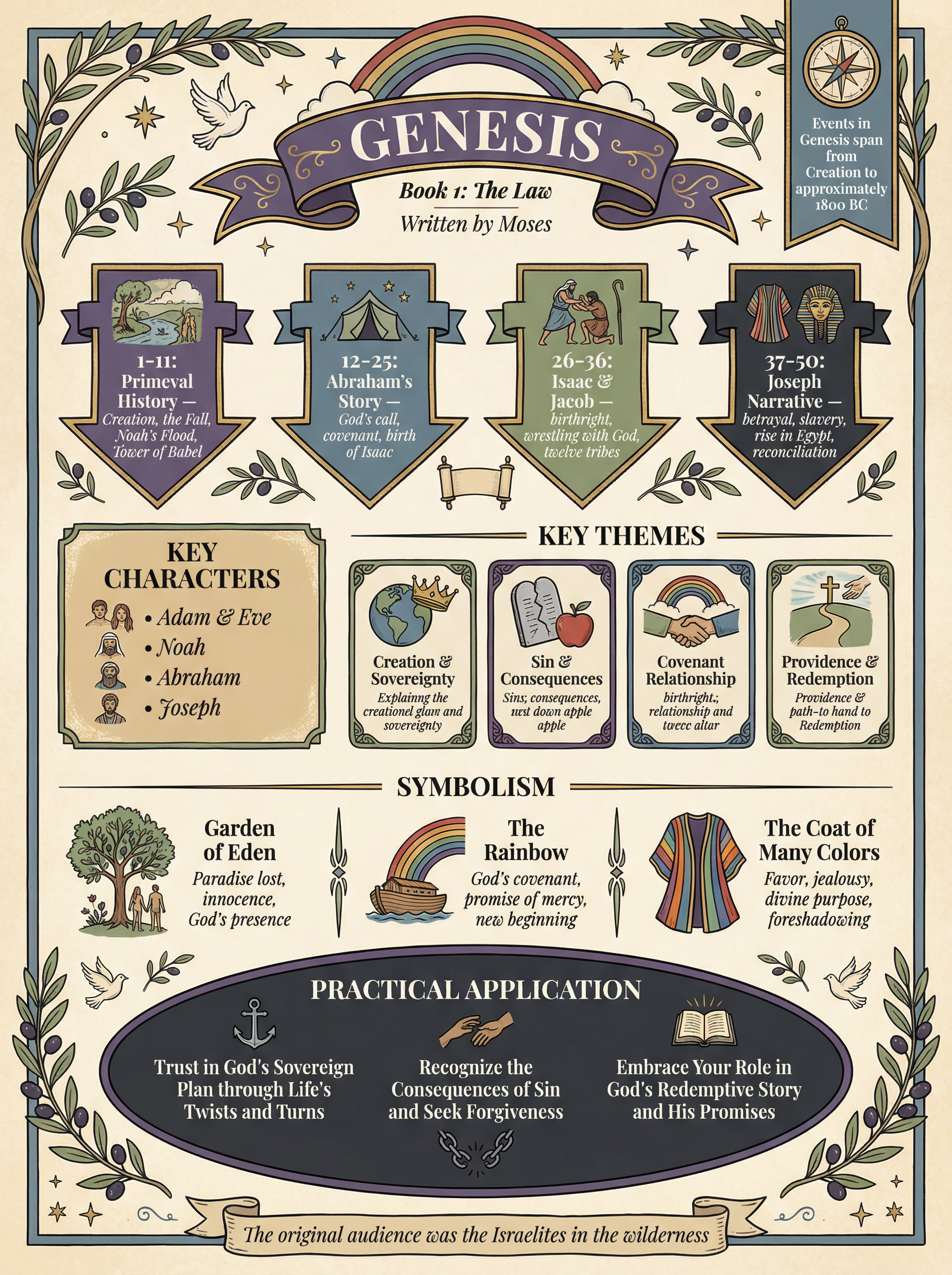
Full-page visual overview of The Book of Genesis — key events, themes, and structure at a glance
The Book of Genesis spans from the creation of the cosmos to the death of Joseph in Egypt — covering thousands of years of primeval and patriarchal history. It is the foundation upon which the entire biblical narrative is built.
The six days of creation. God speaks the cosmos into existence. The seventh day is sanctified as Sabbath rest.
The Garden of Eden. Adam is formed from dust; Eve from Adam's rib. Humanity is placed in the garden to 'work and keep' it.
The Fall. The serpent deceives Eve; Adam follows. God pronounces judgment — but also the first gospel promise (3:15): a seed who will crush the serpent.
Cain kills Abel. Sin spreads. But a line of faithful descendants continues through Seth — 'At that time people began to call on the name of the Lord' (4:26).
Noah and the Flood. God's grief over human wickedness. The ark, the flood, the rainbow covenant: 'Never again will I destroy all living creatures' (8:21).
The Table of Nations and the Tower of Babel. Humanity scattered across the earth — setting the stage for God's call of one man to bless all nations.
Genesis establishes four foundational theological themes that run through the entire Bible — from creation to new creation.
God as Creator and Sovereign
Genesis opens with the most audacious claim in human history: "In the beginning, God created the heavens and the earth." Everything that exists — matter, time, …
The Reality and Reach of Sin
Genesis 3 is the hinge of human history. The serpent's lie — 'You will be like God' — captures the essence of every sin: the desire to be autonomous, to define …
God's Covenant Faithfulness
Despite human failure at every turn — the Fall, Cain's murder, the Flood, Babel, and the patriarchs' repeated deceptions — God keeps initiating covenant relatio…
Providence — God's Hidden Hand
The Joseph narrative (chapters 37–50) is the supreme illustration of divine providence in Genesis. Joseph is betrayed, enslaved, falsely accused, and imprisoned…
Genesis is filled with symbols that operate on historical, theological, and typological levels — pointing forward to Christ and the new creation.
The Rainbow
After the Flood, God placed a rainbow in the sky as a sign of His covenant with Noah and all living creatures (Genesis 9:12–17). In the ancient Near East, the bow was a weapon of war; God 'hanging up' His bow signaled the end of divine judgment.
After the Flood, God placed a rainbow in the sky as a sign of His covenant with Noah and all living creatures (Genesis 9:12–17). In the ancient Near East, the bow was a weapon of war; God 'hanging up' His bow signaled the end of divine judgment.
The rainbow is a visible, recurring reminder of God's grace and restraint. In Revelation 4:3, a rainbow surrounds God's throne — suggesting that even in the context of final judgment, God's covenant mercy frames everything He does.
The Tree of Life
The Tree of Life stood at the center of the Garden of Eden (Genesis 2:9). After the Fall, God placed cherubim and a flaming sword to guard it, preventing humanity from eating its fruit and living forever in a state of sin.
The Tree of Life stood at the center of the Garden of Eden (Genesis 2:9). After the Fall, God placed cherubim and a flaming sword to guard it, preventing humanity from eating its fruit and living forever in a state of sin.
The Tree of Life bookends the entire Bible — it appears first in Eden (Genesis 2) and last in the New Jerusalem (Revelation 22:2), where its leaves are 'for the healing of the nations.' The cross of Christ is the bridge between these two trees.
The Ram at Moriah
When Abraham was about to sacrifice Isaac on Mount Moriah, God provided a ram caught in a thicket as a substitute (Genesis 22:13). Abraham named the place 'The Lord Will Provide' (Yahweh-Jireh).
When Abraham was about to sacrifice Isaac on Mount Moriah, God provided a ram caught in a thicket as a substitute (Genesis 22:13). Abraham named the place 'The Lord Will Provide' (Yahweh-Jireh).
The ram is one of the most powerful types of Christ in the Old Testament — an innocent substitute taking the place of the condemned. Mount Moriah is traditionally identified with the Temple Mount in Jerusalem, where centuries later the ultimate sacrifice would take place.
Joseph's Coat
Jacob gave Joseph a distinctive robe (often translated 'coat of many colors'), marking him as the favored son. His brothers' jealousy over this garment was the catalyst for selling him into slavery.
Jacob gave Joseph a distinctive robe (often translated 'coat of many colors'), marking him as the favored son. His brothers' jealousy over this garment was the catalyst for selling him into slavery.
The coat that marked Joseph for suffering also marked him for glory. It foreshadows how the 'beloved Son' who is rejected and 'sold' becomes the savior of those who rejected him — a pattern fulfilled perfectly in Jesus.
Pharaoh's Seven Years
Pharaoh dreamed of seven fat cows devoured by seven thin cows, and seven full heads of grain swallowed by seven withered ones (Genesis 41). Joseph interpreted this as seven years of abundance followed by seven years of famine.
Pharaoh dreamed of seven fat cows devoured by seven thin cows, and seven full heads of grain swallowed by seven withered ones (Genesis 41). Joseph interpreted this as seven years of abundance followed by seven years of famine.
The dream and its interpretation reveal that God governs history — including the rise and fall of empires — to accomplish His redemptive purposes. Joseph's wisdom in preparation mirrors the biblical call to stewardship: using times of abundance to prepare for times of scarcity.
These 8 questions are designed for a 60–90 minute small group session. Begin with the icebreaker, then work through observation, interpretation, and application questions. Close with the prayer prompt. Leader's notes are available for select questions.
If you could ask God one question about the creation story, what would it be? What draws you to that question?
Read Genesis 3:1–13. Notice how the serpent's question subtly distorts God's words (compare 2:16–17 with 3:1). What tactics does the serpent use? Where do you see similar distortions of God's truth today?
In Genesis 12:1–3, God makes three promises to Abraham. List them. Then trace how each promise unfolds through the rest of Genesis. Which promise do you find most surprising?
Genesis 15:6 says Abram 'believed the Lord, and he credited it to him as righteousness.' This verse is quoted three times in the New Testament (Romans 4, Galatians 3, James 2). What does it mean to be 'credited' with righteousness? How does this challenge a works-based view of faith?
Joseph says to his brothers: 'You intended to harm me, but God intended it for good' (50:20). How does the Joseph narrative redefine what 'good' means? Can you think of a time when something painful in your life was later revealed to have a redemptive purpose?
Genesis shows a pattern: God calls ordinary, flawed people — Abraham lies twice about his wife, Jacob deceives his father, Joseph is arrogant in his youth. What does this pattern tell us about how God works? How does it challenge our tendency to disqualify ourselves from God's calling?
The Sabbath is established in Genesis 2:1–3 before the Fall — it is part of God's original design, not a religious rule. What would it look like to practice genuine rest in your life this week? What makes rest difficult for you?
Close by reading Genesis 50:20 together. Have each person share one area of their life where they are struggling to see God's hand — a situation that feels like 'harm' rather than 'good.' Pray together that God would grant the eyes to see His hidden purposes, even in the hardest chapters.
The Book of Genesis
"You intended to harm me, but God intended it for good to accomplish what is now being done, the saving of many lives."
— Genesis 50:20
Continue Your Study