The Book of Proverbs
Ancient Wisdom for Everyday Life — From the Court of Solomon
Phase 1 · Foundations
Appears 3 times · Day 19–23 · Tap to see details
Phase 2 · Depth
Appears 1 times · Day 63–63 · Tap to see details
Phase 3 · Integration
Appears 3 times · Day 21–70 · Tap to see details
Click to view in Reading Plan →
"Trust in the Lord with all your heart and lean not on your own understanding; in all your ways submit to him, and he will make your paths straight."
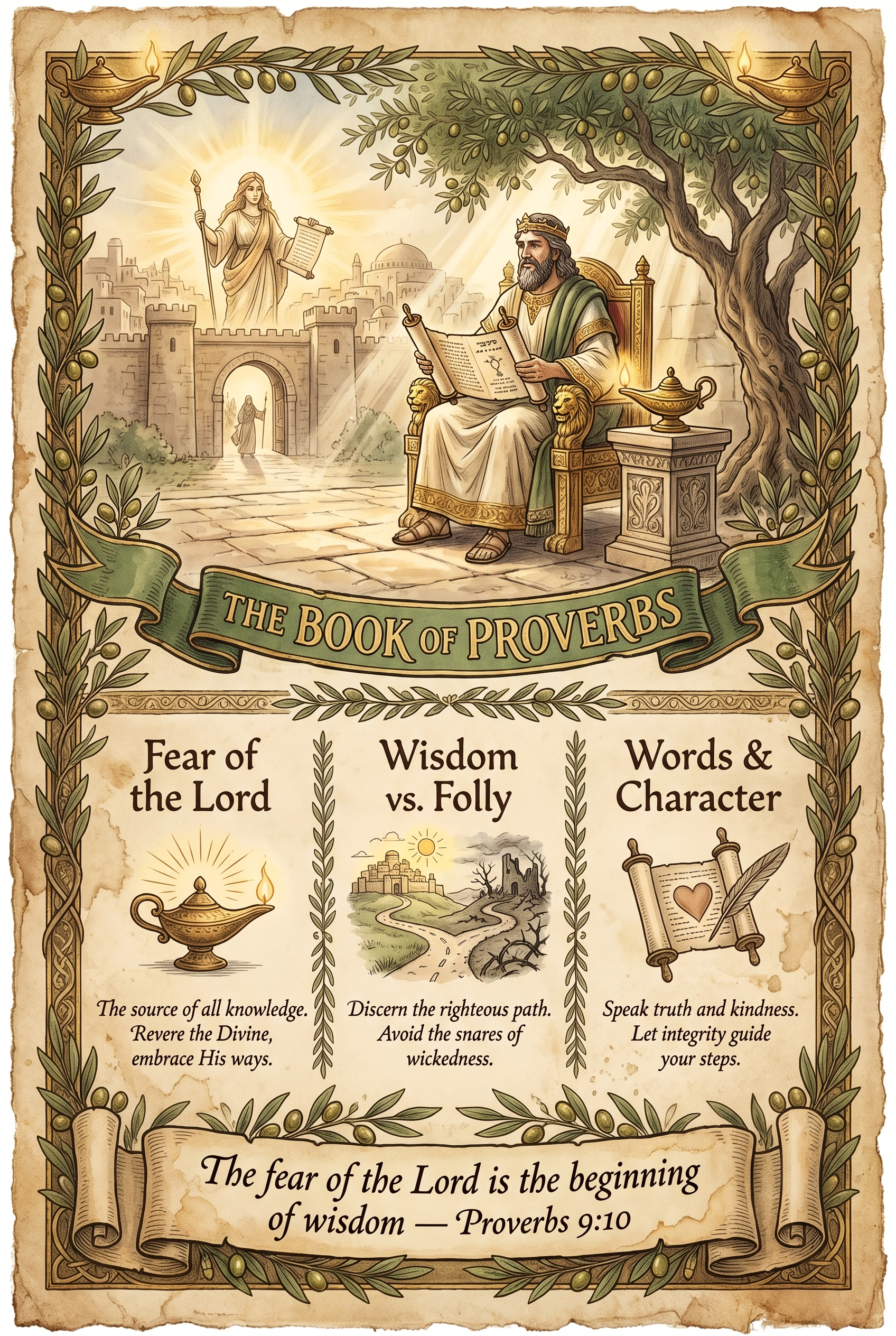
Full-page visual overview of The Book of Proverbs — key events, themes, and structure at a glance
The Book of Joshua spans approximately 1400 BC and records the fulfillment of God's promise to give the land of Canaan to the Israelites. Written by Joshua himself, it is a story of faith, obedience, military conquest, and covenant renewal.
"The fear of the Lord is the beginning of wisdom" — the thesis statement of the entire book. Wisdom is not merely intellectual; it begins with a right relationship to God.
Lady Wisdom cries out in the streets, at the city gates, in the public square. She is not hidden or esoteric — she is accessible to all who will listen. Those who reject her bear the consequences; those who heed her dwell secure.
"Trust in the Lord with all your heart and lean not on your own understanding." The most beloved passage in Proverbs: total surrender to God's guidance rather than self-reliance. Discipline is a sign of God's love, not His anger.
Wisdom's great self-disclosure: she was present at creation, delighting in God's work. "Whoever finds me finds life and receives favor from the Lord." This passage points forward to Christ as the wisdom of God (1 Corinthians 1:24).
The Book of Joshua is built around four interlocking theological themes that speak powerfully to modern believers navigating their own "promised lands."
The Fear of the Lord
The thesis statement of Proverbs is "the fear of the Lord is the beginning of wisdom" (1:7; 9:10). This is not fear as terror but as reverent awe — a posture of…
Wisdom vs. Folly
Proverbs presents two paths with two destinations. Wisdom leads to life, flourishing, and the favor of God. Folly leads to ruin, shame, and death. These are not…
Words and Speech
No theme in Proverbs receives more attention than the power of words. The tongue can bring life or death (18:21), healing or destruction (12:18), peace or confl…
Diligence and Character
Proverbs is intensely practical about work, money, and character formation. The sluggard appears repeatedly as a cautionary figure — full of excuses, unwilling …
Joshua is rich with symbolic imagery operating on multiple levels — historical, theological, and typological. Toggle between the two lenses to explore each symbol's full meaning.
The Tree of Life
The tree of life first appears in Genesis 2 as a literal tree in the Garden of Eden, access to which was blocked after the Fall (Genesis 3:24). In the ancient Near East, the tree of life was a common symbol of divine blessing and immortality. Proverbs uses it as a metaphor: wisdom is a tree of life (3:18), the fruit of the righteous is a tree of life (11:30), a longing fulfilled is a tree of life (13:12).
The tree of life first appears in Genesis 2 as a literal tree in the Garden of Eden, access to which was blocked after the Fall (Genesis 3:24). In the ancient Near East, the tree of life was a common symbol of divine blessing and immortality. Proverbs uses it as a metaphor: wisdom is a tree of life (3:18), the fruit of the righteous is a tree of life (11:30), a longing fulfilled is a tree of life (13:12).
Proverbs' use of the tree of life imagery suggests that wisdom is the path back to Eden — to the life God originally intended. The New Jerusalem in Revelation 22 features the tree of life bearing fruit for the healing of the nations, suggesting that the wisdom journey of Proverbs points toward the ultimate restoration of all things.
Lady Wisdom and Dame Folly
In Proverbs 1–9, Wisdom and Folly are personified as two women calling out to young men in the city streets. This was a common literary device in ancient Near Eastern wisdom literature. The contrast between the two women would have been immediately recognizable to the original audience as a choice between two paths of life.
In Proverbs 1–9, Wisdom and Folly are personified as two women calling out to young men in the city streets. This was a common literary device in ancient Near Eastern wisdom literature. The contrast between the two women would have been immediately recognizable to the original audience as a choice between two paths of life.
Lady Wisdom is not merely a literary device — she is the personification of God's own ordering of creation. In Proverbs 8, she was present at creation, delighting in God's work. The New Testament identifies Christ as the wisdom of God (1 Corinthians 1:24, 30; Colossians 2:3), suggesting that Lady Wisdom is a foreshadowing of Christ Himself.
The Craftsman / Artisan
Proverbs 8:30 describes Wisdom as an 'amon' — a Hebrew word that can mean craftsman, artisan, or master workman. The image is of Wisdom as a skilled craftsperson working alongside God in creation, delighting in the work and in the human beings being made.
Proverbs 8:30 describes Wisdom as an 'amon' — a Hebrew word that can mean craftsman, artisan, or master workman. The image is of Wisdom as a skilled craftsperson working alongside God in creation, delighting in the work and in the human beings being made.
The craftsman image suggests that wisdom is not just knowledge but skill — the ability to apply truth to the material of everyday life. Just as a craftsman shapes raw material into something beautiful and useful, wisdom shapes the raw material of our circumstances, relationships, and choices into a life that reflects God's design.
The Scroll / Written Word
Proverbs was written to be memorized and internalized — the repeated commands to "bind them on your heart" (3:3; 6:21; 7:3) reflect the ancient practice of wearing phylacteries (small scrolls of Scripture) as a physical reminder of God's commands. The written word was not just information; it was a formative presence.
Proverbs was written to be memorized and internalized — the repeated commands to "bind them on your heart" (3:3; 6:21; 7:3) reflect the ancient practice of wearing phylacteries (small scrolls of Scripture) as a physical reminder of God's commands. The written word was not just information; it was a formative presence.
The emphasis on writing wisdom on the heart anticipates the New Covenant promise of Jeremiah 31:33: "I will put my law in their minds and write it on their hearts." Proverbs' goal is not external compliance but internal transformation — a heart so shaped by wisdom that righteous living flows naturally from the inside out.
These 8 questions are designed for a 60–90 minute small group session. Begin with the icebreaker, then work through observation, interpretation, and application questions. Close with the prayer prompt. Leader's notes are available for select questions.
What is the wisest piece of advice you have ever received? Who gave it to you, and what made it so memorable?
Read Proverbs 3:1–12 aloud. How many different commands does Solomon give in these 12 verses? What do they have in common? What does this passage reveal about the relationship between wisdom and trust?
Compare Proverbs 26:4 ("Do not answer a fool according to his folly") with Proverbs 26:5 ("Answer a fool according to his folly"). These two verses appear side by side. What does this apparent contradiction tell us about the nature of wisdom?
Proverbs 8:22–31 describes Wisdom as present at creation, delighting in God's work. The New Testament identifies Christ as the wisdom of God (1 Corinthians 1:24). How does reading Proverbs 8 through the lens of Christ change how you understand both passages?
Proverbs 31:10–31 ends the book with a portrait of the Noble Woman rather than a list of rules. Why do you think the book ends with a person rather than a principle? What does this tell us about the goal of wisdom?
Proverbs 18:21 says "the tongue has the power of life and death." Think about your conversations this past week. Were there moments when your words brought life? Were there moments when they brought something less than life? What would it look like to be more intentional about your speech?
Proverbs consistently warns against pride and commends humility. "Pride goes before destruction" (16:18). Where do you see pride operating in your own life — in your relationships, your work, your spiritual life? What would a humble response look like in that specific area?
Close by reading Proverbs 3:5–6 together: "Trust in the Lord with all your heart and lean not on your own understanding; in all your ways submit to him, and he will make your paths straight." Have each person share one area of life where they are currently leaning on their own understanding. Then pray together, surrendering those areas to God's wisdom.
Solomon
Israel's wisest king, who composed the majority of Proverbs as a guide for righteous and skillful living.
Lady Wisdom
A personification of divine wisdom who calls out in the streets, inviting all to choose understanding over folly.
The Noble Woman
The virtuous woman of Proverbs 31, whose strength, dignity, and wisdom embody the book's highest ideals.
Wisdom Begins with Humility
Proverbs teaches that the wise person is always learning, open to correction, and quick to listen.
Guard Your Words
Before speaking, Proverbs invites us to ask: Is it true? Is it kind? Is it necessary? Words shape reality.
Character Over Comfort
The book consistently values integrity, diligence, and generosity over wealth, status, or ease.
We use cookies
We use cookies and similar technologies to enhance your study experience, remember your progress, and understand how our service is used. You can choose which cookies to allow. Privacy Policy
California residents: we do not sell your personal information. Your rights →
This service is intended for users 13 years of age or older. Terms →