The Letter to the Romans
The Great Charter of the Christian Faith — Salvation by Grace Through Faith
Phase 1 · Foundations
Appears 1 times · Day 96–96 · Tap to see details
Phase 2 · Depth
Appears 5 times · Day 16–58 · Tap to see details
Phase 3 · Integration
Appears 5 times · Day 10–92 · Tap to see details
Click to view in Reading Plan →
"For I am not ashamed of the gospel, because it is the power of God that brings salvation to everyone who believes: first to the Jew, then to the Gentile."
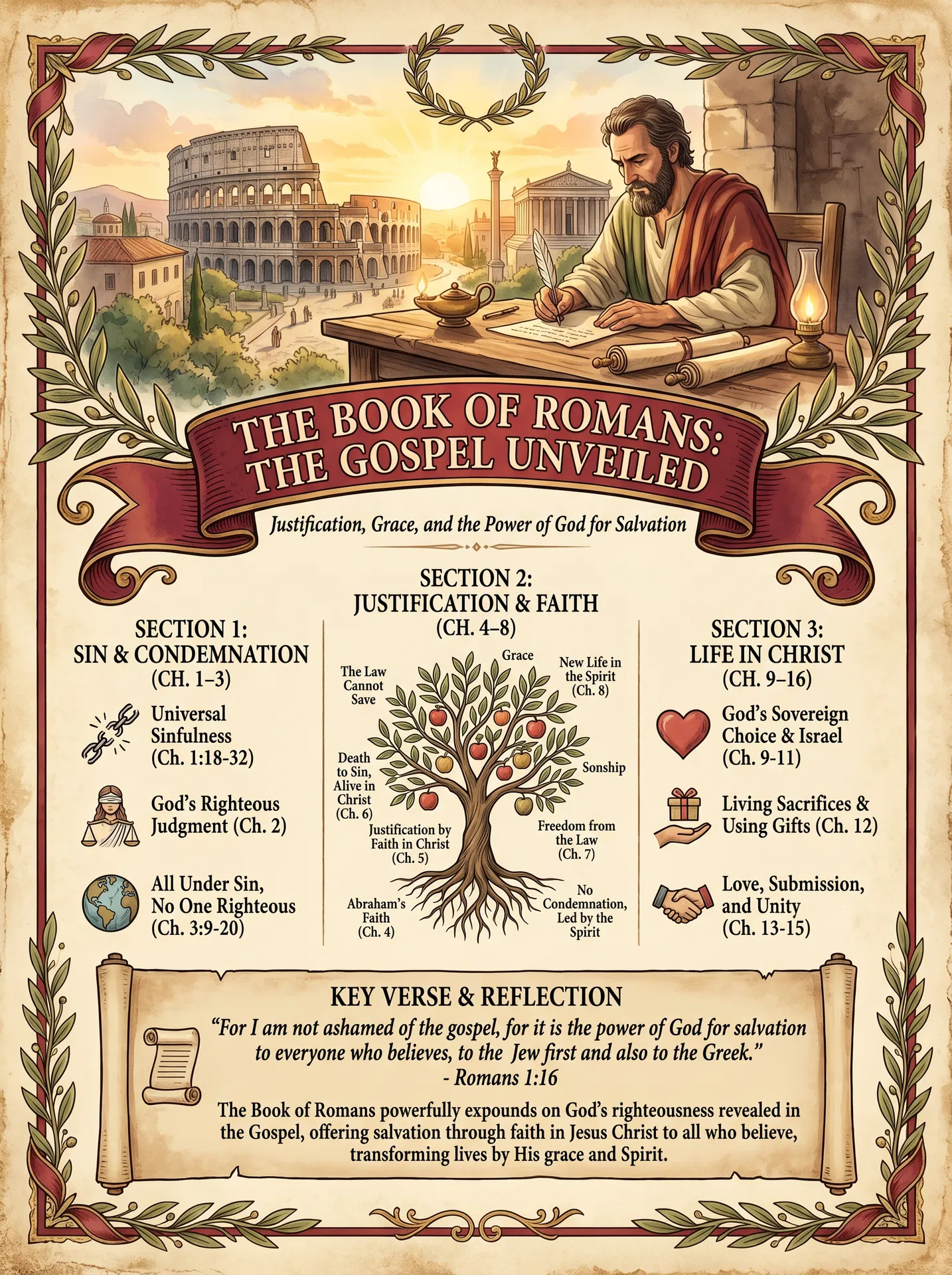
Full-page visual overview of The Letter to the Romans — key events, themes, and structure at a glance
The Book of Joshua spans approximately 1400 BC and records the fulfillment of God's promise to give the land of Canaan to the Israelites. Written by Joshua himself, it is a story of faith, obedience, military conquest, and covenant renewal.
Paul's introduction: the gospel is the power of God for salvation. His famous thesis: "The righteous shall live by faith" (1:17, quoting Habakkuk 2:4). This single verse launched the Protestant Reformation.
The Gentile's guilt: humanity suppressed the truth about God revealed in creation. The downward spiral of idolatry and moral corruption. God's judgment is just because He judges according to truth.
The Jew's guilt: possessing the law does not exempt from judgment. Circumcision is a matter of the heart. "God's name is blasphemed among the Gentiles because of you" (2:24).
"There is no one righteous, not even one" (3:10). The entire human race stands condemned. But then: "But now apart from the law the righteousness of God has been made known" — through faith in Jesus Christ.
The Book of Joshua is built around four interlocking theological themes that speak powerfully to modern believers navigating their own "promised lands."
Justification by Faith
The central thesis of Romans is that sinful human beings can be declared righteous before a holy God — not by keeping the law, but through faith in Jesus Christ…
The Power of the Gospel
Paul opens Romans with a bold declaration: "I am not ashamed of the gospel, because it is the power of God that brings salvation to everyone who believes" (1:16…
Life in the Spirit (Romans 8)
Romans 8 is widely considered the greatest chapter in the Bible. It opens with "no condemnation" and closes with "nothing can separate us from the love of God."…
The Transformed Mind
Romans 12:1–2 is the great hinge of the letter, transitioning from doctrine to practice. Paul's appeal is "by the mercies of God" — the entire argument of chapt…
Joshua is rich with symbolic imagery operating on multiple levels — historical, theological, and typological. Toggle between the two lenses to explore each symbol's full meaning.
The Courtroom
Paul was a trained Pharisee who knew Roman law. He uses the language of the Roman courtroom throughout Romans: justified (declared righteous), condemned, verdict, acquitted. Roman courts were the most sophisticated legal system in the ancient world, and Paul's audience in Rome would have understood every legal term immediately.
Paul was a trained Pharisee who knew Roman law. He uses the language of the Roman courtroom throughout Romans: justified (declared righteous), condemned, verdict, acquitted. Roman courts were the most sophisticated legal system in the ancient world, and Paul's audience in Rome would have understood every legal term immediately.
The courtroom imagery reveals the seriousness of sin (it requires a verdict) and the miracle of grace (the verdict is "not guilty" for those in Christ). God is both the just Judge who cannot ignore sin and the gracious Father who provides the payment Himself through Christ.
The Olive Tree
The olive tree was the most economically and symbolically important tree in the ancient Mediterranean world. Olive oil was used for food, light, medicine, and religious ceremony. Israel had long been described as God's olive tree (Jeremiah 11:16; Hosea 14:6). Wild olive branches were sometimes grafted onto cultivated trees to improve yield.
The olive tree was the most economically and symbolically important tree in the ancient Mediterranean world. Olive oil was used for food, light, medicine, and religious ceremony. Israel had long been described as God's olive tree (Jeremiah 11:16; Hosea 14:6). Wild olive branches were sometimes grafted onto cultivated trees to improve yield.
In Romans 11:17–24, Paul uses the olive tree to explain the relationship between Israel and the Gentiles in God's redemptive plan. Gentile believers are wild branches grafted into the cultivated tree of Israel's covenant history. This image warns against Gentile arrogance and affirms God's ongoing faithfulness to Israel.
Slavery and Freedom
Slavery was ubiquitous in the Roman Empire — estimates suggest 30–40% of the population of Rome were slaves. Paul's audience would have included both slaves and slave owners. The language of manumission (the legal freeing of a slave) was immediately understood as a picture of liberation.
Slavery was ubiquitous in the Roman Empire — estimates suggest 30–40% of the population of Rome were slaves. Paul's audience would have included both slaves and slave owners. The language of manumission (the legal freeing of a slave) was immediately understood as a picture of liberation.
Paul uses slavery as a theological category in Romans 6: before Christ, we were slaves to sin; after Christ, we are slaves to righteousness. The paradox is that true freedom is found in willing submission to God. "You have been set free from sin and have become slaves to righteousness" (6:18).
Adoption
Roman adoption was a serious legal act that gave the adopted child full rights as a natural-born son — including inheritance rights and the father's name. A Roman adoption could not be reversed. Paul's audience would have understood that adoption created a permanent, legally binding relationship.
Roman adoption was a serious legal act that gave the adopted child full rights as a natural-born son — including inheritance rights and the father's name. A Roman adoption could not be reversed. Paul's audience would have understood that adoption created a permanent, legally binding relationship.
Romans 8:15–17 describes believers as adopted children of God who cry "Abba, Father" — the intimate Aramaic term Jesus used. This adoption is permanent (nothing can separate us from God's love, 8:38–39), gives us full inheritance rights (co-heirs with Christ), and transforms our identity from slaves to sons and daughters.
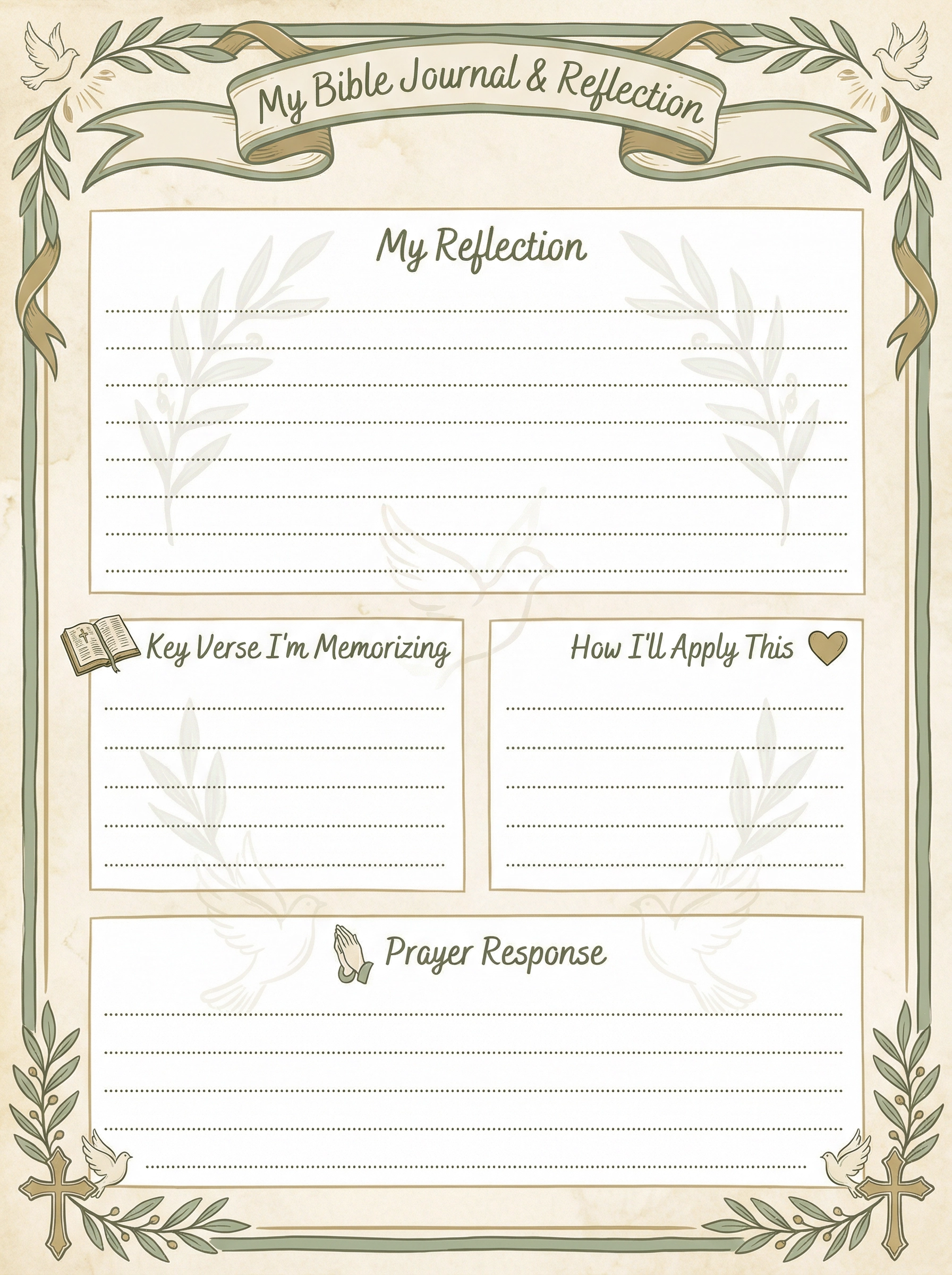
These 8 questions are designed for a 60–90 minute small group session. Begin with the icebreaker, then work through observation, interpretation, and application questions. Close with the prayer prompt. Leader's notes are available for select questions.
Paul says he is "not ashamed of the gospel" (Romans 1:16) — implying it was something people could be ashamed of. Have you ever felt hesitant to share your faith? What made it feel risky?
Read Romans 3:21–26 carefully. Paul uses five different metaphors for salvation in these six verses: justification (courtroom), redemption (slave market), propitiation (temple sacrifice), righteousness (moral standing), and faith. What does the density of these images tell us about the richness of what Christ accomplished?
Romans 5:3–5 says we rejoice in our sufferings because they produce perseverance, character, and hope. Compare this with Romans 8:18: "our present sufferings are not worth comparing with the glory that will be revealed." How do these two passages together shape a Christian theology of suffering?
Romans 7:15–19 describes a painful inner conflict: "I do not do what I want, but I do the very thing I hate." Is Paul describing his experience before or after conversion? What does this passage tell us about the ongoing struggle with sin in the Christian life?
Romans 9:20–21 uses the image of the potter and the clay. How do you respond to Paul's argument for God's sovereignty? Does it comfort you or trouble you? What questions does it raise for you?
Romans 12:2 calls us to be "transformed by the renewing of your mind." What specific thought patterns, beliefs, or assumptions in your life most need to be renewed by the gospel? What would it look like to actively work on one of them this week?
Romans 8:38–39 lists ten things that cannot separate us from God's love. Which of these ten threats feels most real to you right now — death, life, angels, demons, present, future, powers, height, depth, or anything else in creation? How does Paul's declaration speak to that specific fear?
Close by reading Romans 8:1 and 8:38–39 together. Have each person share one thing they have been carrying that they need to release to God — guilt, fear, uncertainty, or grief. Then pray together, declaring over each person: "Nothing can separate you from the love of God in Christ Jesus."
Paul
The apostle to the Gentiles, who wrote this theological masterpiece while in Corinth.
Abraham
Used as the prime example of justification by faith apart from works.
Adam
Contrasted with Christ — Adam brought sin and death; Christ brings righteousness and life.
Renew Your Mind
Romans 12:2 calls believers to transformation through the renewing of the mind — not conforming to the world's patterns.
Nothing Can Separate You
Romans 8:38-39 offers the most comprehensive assurance in Scripture — nothing in all creation can separate us from God's love.
Live at Peace
Paul's practical instructions in Romans 12-15 provide a blueprint for loving community life.
John
The Word became flesh — the divine identity of Jesus Christ
Best for exploring who Jesus is — deeply personal and vivid
"For God so loved the world that he gave his one and only Son, that whoever believes in him shall not perish but have eternal life."
— John 3:16
Revelation
The unveiling of Christ's ultimate victory over evil
For readers ready to explore prophecy, hope, and the end of history
"He who testifies to these things says, 'Yes, I am coming soon.' Amen. Come, Lord Jesus."
— Revelation 22:20The Letter to the Romans
"For I am convinced that neither death nor life, neither angels nor demons, neither the present nor the future, nor any powers, neither height nor depth, nor anything else in all creation, will be able to separate us from the love of God that is in Christ Jesus our Lord."
— Romans 8:38–39
Continue Your Study
We use cookies
We use cookies and similar technologies to enhance your study experience, remember your progress, and understand how our service is used. You can choose which cookies to allow. Privacy Policy
California residents: we do not sell your personal information. Your rights →